There are not many books that provide a detailed scientific explanation of the actions and functions of “water.” Scientific understanding of “microorganisms” has advanced primarily in fields directly related to humans (such as fermented foods, gut bacteria, and pharmaceuticals). Human knowledge regarding both “water” and “microorganisms” remains extremely limited. Earth is said to have formed approximately 4.54 billion years ago, with “water” appearing about 4.4 billion years ago. Water is essential for sustaining life; it was brought to Earth in some form—possibly via rocks containing ice that included hydrogen and oxygen—and became the source of life. Water is indispensable for the birth and activity of life (for instance, moss becomes active when it receives water, enters a dormant state when dry, and revives upon regaining moisture). Water changes its state instantaneously (liquid ⇔ gas ⇔ solid). Comets also contain ice formed under high pressure. Sound travels faster in water than in air (whales and dolphins utilize this rapid wave transmission in water). Water dissolves, mixes, and transports substances (such as sugars, vitamins, minerals, heat, and “hormones” linked to emotions) while facilitating information transmission (for example, mycelial networks transmit information about distant conditions, a process that likely involves trees, fungi, water, and ions). Water drives various cycles—such as climate patterns, excretion, and purification—within natural and biological environments. It also plays a role in taking necessary substances into the body and performing purification functions. Furthermore, water plays a part in altering the global environment (through glaciers that erode terrain, as well as impacts on atmospheric circulation, including climate, ocean currents, and prevailing westerlies).
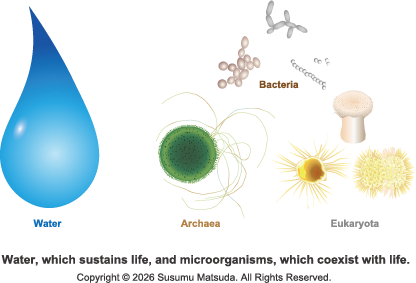
Regarding “microorganisms” and the origin of life, methanogenic archaea have been discovered in geological strata dating back 3.5 billion years. “Eukaryotes”—the cells that make up animals, plants, and fungi—are believed to have originated from archaea. Microorganisms are the most numerous life forms on Earth, having emerged before plants, insects, and animals. Fungi and plants form symbiotic relationships mediated by mycorrhizal fungi, exchanging sugars and phosphorus and sharing information through networks of hyphae. However, if such networks are severed—for instance, by a fallen tree—restoring them takes time. Furthermore, hyphae cannot survive in soil that has been compacted by trampling. Symbiotic relationships also exist between microorganisms and animals (such as on the skin or within the gut), aiding in processes like the breakdown of substances and the absorption of nutrients. Beneficial microorganisms support human health (found in fermented foods and gut microbiota, and often inherited from the mother, though some animals ingest feces to replenish necessary bacteria), and these symbiotic relationships help maintain the body in a normal, healthy state. There is even speculation that the collective “consciousness” of symbiotic microorganisms within the body—such as gut bacteria—may influence human will. Humans also utilize microorganisms in medicine, for example, in the production of antibiotics. While research is ongoing, the sheer diversity of microorganisms means that only a fraction of their full nature has been elucidated. I believe that a deeper understanding of the roles played by water and microorganisms is essential to ensuring safety and peace of mind.