Let’s consider the process leading from safety to security. In our daily lives, people psychologically eliminate the risk of disasters, assuming that disasters will not occur in their immediate surroundings. Therefore, when a disaster occurs in our immediate surroundings, we recognize the danger and feel fear. However, over time, we forget about the disaster. After a certain amount of time has passed, people learn to avoid disasters and no longer feel fear. This tendency to forget important disasters is a characteristic of the brain. Based on this hypothesis, continuous efforts are needed to increase people’s safety and security. To increase safety, we need to learn about disasters and seek ways to avoid them on a daily basis. It has been shown that simulating a disaster increases risk sensitivity, which helps people learn to fear disasters and maintain that fear. Actual fearful experiences record important information in the brain’s memory neurons and DNA. Once risk sensitivity is enhanced, people consciously recognize and acknowledge disasters. Through these processes, true disaster vigilance becomes possible.
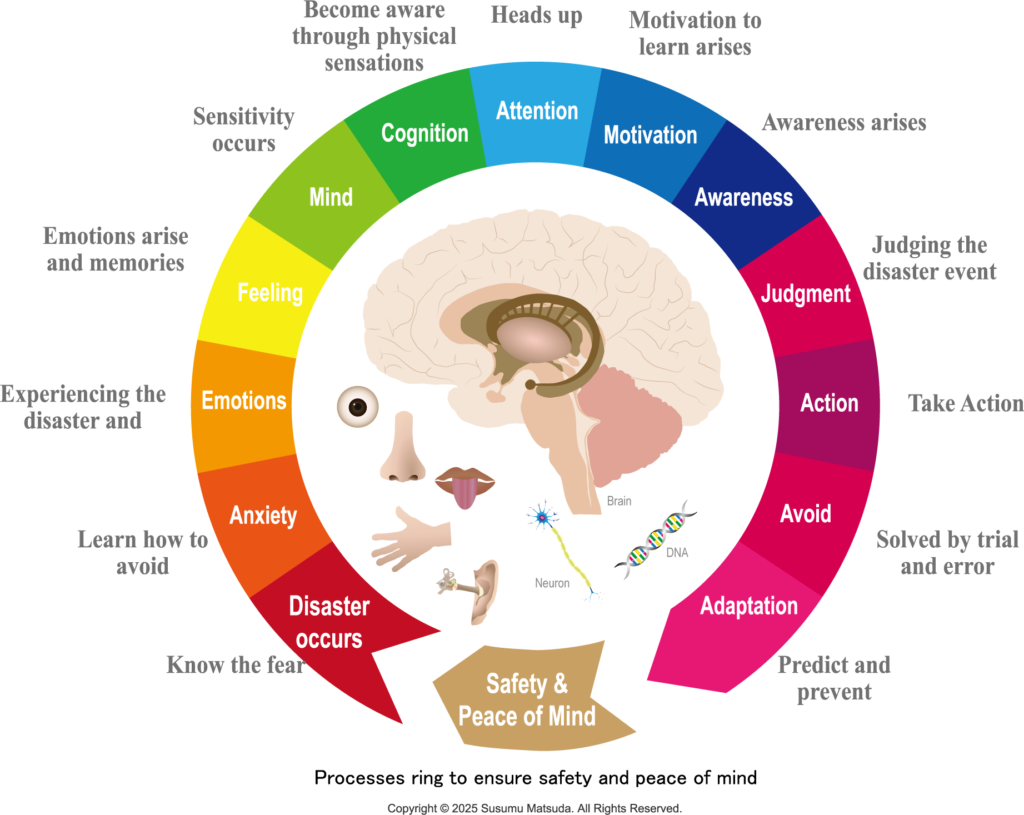
While safety has been ensured so far, to further increase security, it is important to actively practice processes to prevent disasters before they occur. In addition to raising awareness of disaster prevention, students will research disaster prevention methods to prevent and predict disasters, and by thinking about ways to avoid disasters, they will increase their motivation to avoid disasters. By repeating this process, disaster prevention awareness will eventually increase. Students will learn and keep in mind that only by training to be able to make quick decisions when a disaster occurs and always taking the initiative and doing their best to protect themselves can they increase the chances of survival. It is also important to regularly conduct simulations and drills, and to use trial and error to come up with solutions to avoid disasters. Through this process, disaster preparedness will accumulate, leading to peace of mind. It is important to continually practice this peace of mind process.