Japan’s forest coverage is extremely high at 67%, surprisingly ranking third in the world after Finland and Sweden. This high forest coverage has been maintained for 150 years. 40% of Japan’s forests are plantations, consisting of cedar, cypress, and larch trees. The remaining 60% are natural forests, 80% of which are broadleaf trees. Broadleaf trees include the acorn-bearing Fagaceae family, including konara oak, Kubugi (Japanese oak), Shii (castor beech), chestnut, and Japanese beech. However, it is safe to say that the Japanese beech population is declining. Pine and beech trees are part of an important ecosystem. Lichens and mosses grow abundantly in the crevices of the bark of pine and beech trees. Furthermore, mycorrhizae, a symbiotic relationship between fungi and roots, form on the roots. Fungi produce organic matter and antibiotics, and share sugars, which are the tree’s nutrients, with the fungi, creating a symbiotic relationship. In this way, natural forests are home to mycorrhizae that have formed over hundreds of years.
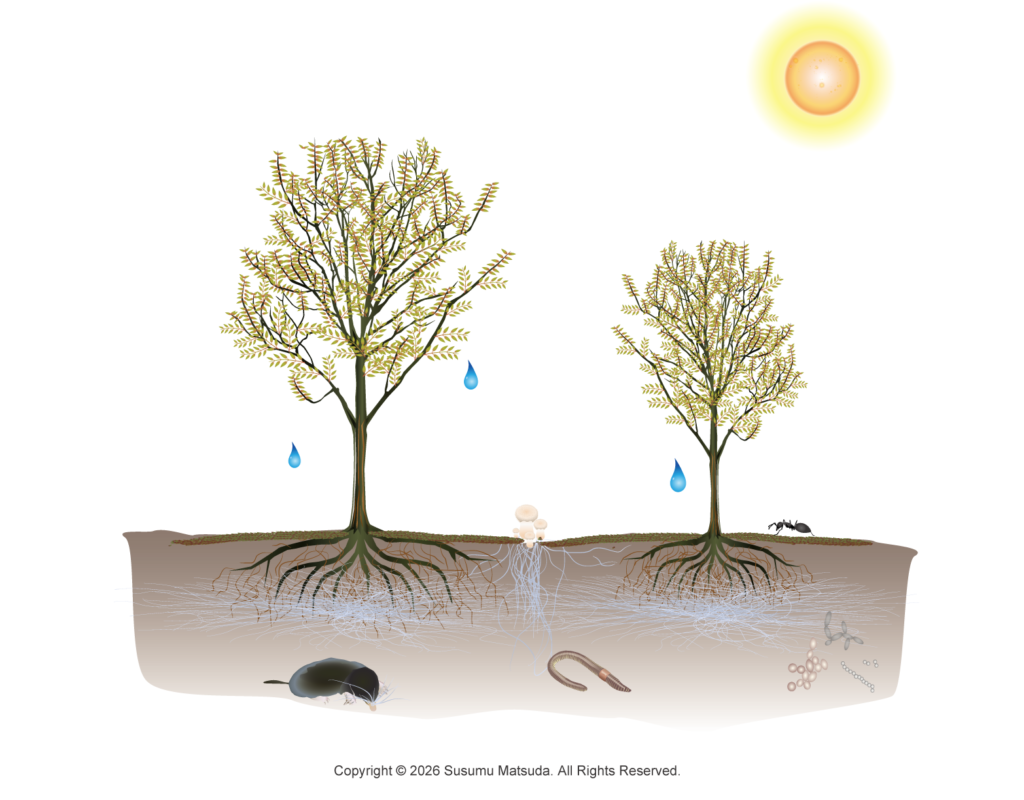
Plants with mycorrhizae eventually connect with each other through mycelium, forming a network on Earth. This results in the formation of a mycorrhizal network underground in the forest. It is known that mycorrhizal networks connect multiple plants with hyphae, sharing nutrients with plants that are lacking them and transmitting information essential for survival. In this way, mycorrhizal networks help plants, including different species, to coexist symbiotically. It appears that mycorrhizal networks function as a mechanism for natural forests to flourish, including both flora and fauna. The mycorrhizal hyphae that form mycorrhizal networks produce mushrooms to spread the fungus. Matsutake mushrooms grow on Japanese red pine, and Maitake mushrooms grow on Japanese oak. However, the population of beech trees is on the decline, and the valuable mycorrhizal network appears to be continuing to decline. Considering the impact that the decline of natural forests has on the environment, I believe it is important to build a safe and secure society while maintaining natural forests.