To ensure safety and health, it is essential to constantly refresh both mind and body. A balanced diet revitalizes the body’s cells; through cell division, new cells are supplied, maintaining the body’s overall soundness. Most parts of the human body—such as the skin, intestines, and blood—undergo constant cell division to replenish cells. In contrast, cells in tissues like muscles, bones, and peripheral nerves do not divide unless tissue damage occurs. Therefore, one must act proactively and consciously apply stress to induce change. When strength training places stress on the body, muscles become fatigued, soreness develops, and tissue damage occurs. This triggers cell division, replacing old tissue with new tissue. Similarly, the load from exercise stimulates cell division in bones, supplying new cells to regenerate tissue. In this way, strength training regenerates cells by placing stress on muscles, bones, and nerves. In short, there are organs that regenerate cellular tissue only in response to the stress of exercise. As mentioned in Blog 18, a balanced diet and strength training promote cellular turnover throughout the body and open pathways to access genes.
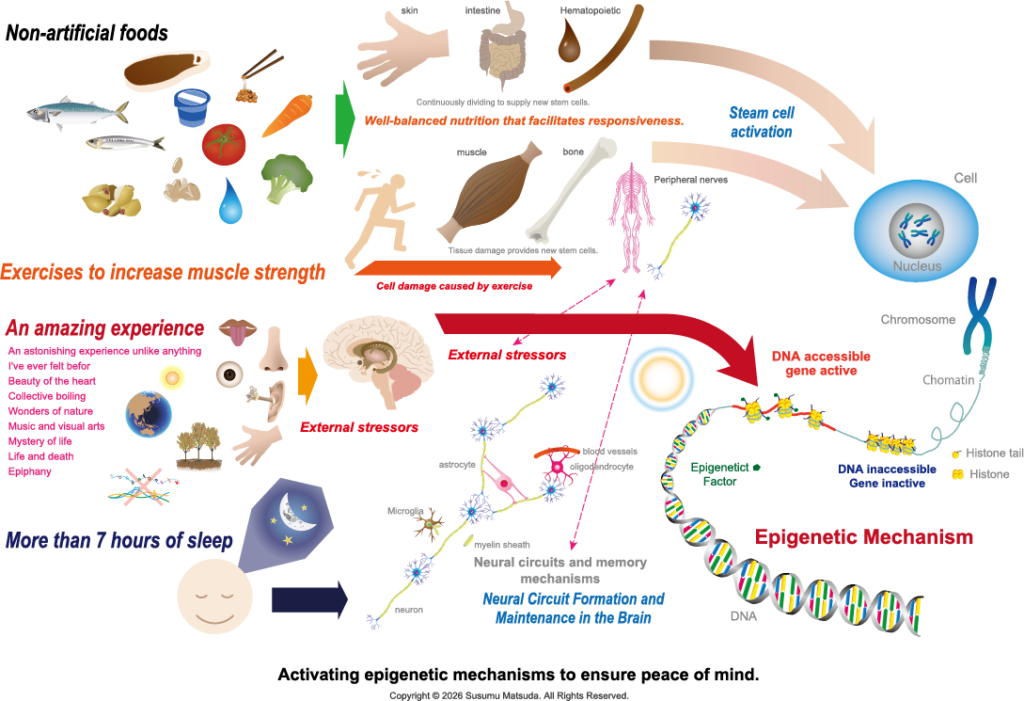
Sleep is essential not only for enhancing brain performance but also for recovering from physical fatigue. Flipping the genetic switch requires special experiences accompanied by strong emotions. Genes undergo cell division while repeatedly transcribing copies into RNA. Genes possess a mechanism known as “epigenetics” that acts as an on/off switch for their functions. This mechanism allows organisms to survive and adapt when faced with sudden environmental changes. Genetic mutation is not the only form of genetic change; activating epigenetics requires repeatedly experiencing events that evoke strong emotions. This process begins by tagging specific sites where gene functions are switched on or off. When an experience is repeated, a “tag” is established; by adjusting the spacing of histones—the proteins around which DNA is wrapped—direct access to these gene tags becomes possible. It is known that this process switches genes on and off. To maintain a sense of security, one must steer oneself in a direction that sustains life; this requires taking action and experiencing a moderate amount of external stress. In other words, regularly experiencing moderate stress is essential for maintaining safety and peace of mind. Stress comes in both positive and negative forms, and it is vital to experience each of them alternately and regularly. It is no exaggeration to say that human safety is built upon stress.